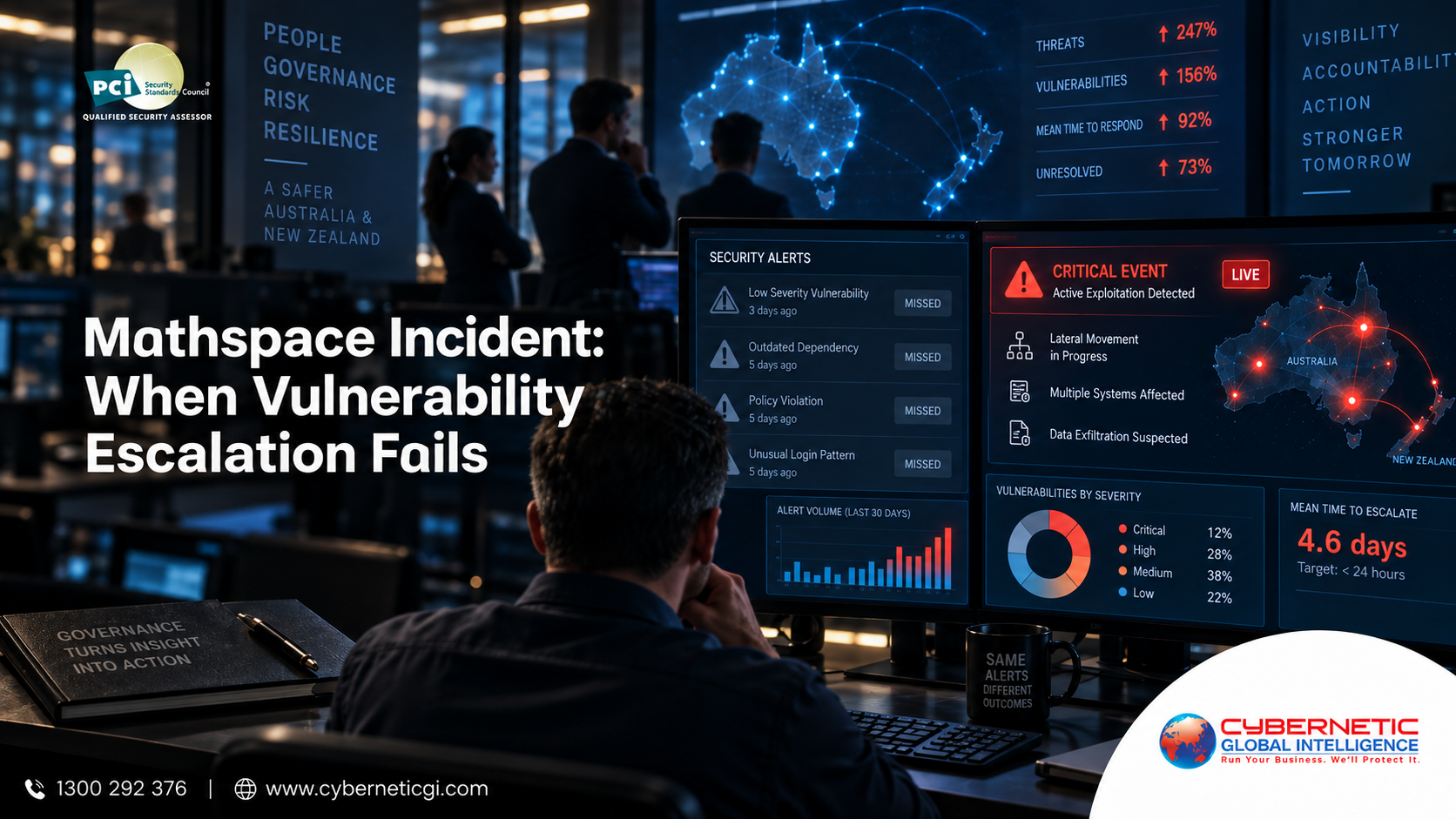
A critical vulnerability does not become a governance issue only when an attacker exploits it. The governance issue begins earlier: when an organisation cannot prove that security advisories are identified, assigned, escalated and remediated within defined timeframes.
That is the central lesson from the Mathspace data breach confirmed on 3 September 2026. Attackers exploited a vulnerability in the education technology provider’s self-hosted Metabase reporting environment. Metabase had released a critical advisory and patched versions on 6 August. Mathspace later acknowledged that its vulnerability-notification process did not identify and escalate that advisory for action.
Unauthorised access was traced back to 10 August, information was downloaded on 27 August, and the affected Metabase instance was updated on 29 August. More than one million people across Australia and New Zealand were affected.
When a Security Alert Becomes a Board Issue
The immediate technical question is why the vulnerability was not patched sooner. The governance question is broader: what control was supposed to detect the advisory, who owned the response, what remediation timeframe applied, and what happened when the normal process failed?
A mature vulnerability-management process should not depend on one automated notification. It should define ownership, severity thresholds, remediation SLAs, escalation paths, exception approval and evidence of closure. Cybersecurity testing should then validate whether those controls work in practice rather than simply confirm that a policy exists.
Boards and executives should be able to ask:
• How are critical vendor advisories received and prioritised?
• Who is accountable for tracking remediation of high-severity vulnerabilities?
• What happens if an automated alert does not create an internal ticket?
• Who approves a delay, and how is that exception documented?
• What evidence reaches leadership to show that critical findings have been closed?
If those questions cannot be answered with evidence, the organisation has an assurance gap.
Patching Is Not the End of the Control
The Mathspace incident also demonstrates why delayed remediation requires more than installing an update. When a critical vulnerability has remained exposed, the organisation must determine whether exploitation occurred during that window.
That requires reliable logging, access records, defined investigation criteria and a process for preserving evidence. A vulnerability assessment should therefore examine not only whether weaknesses are identified, but also whether the business has a repeatable process for escalation, remediation verification and post-exposure investigation.
This matters for compliance as well as security. When personal information may have been compromised, management needs defensible evidence to support breach assessment, regulatory notification, executive decisions and communications. In Australia and New Zealand, that can involve engagement with privacy and cybersecurity authorities. Poor records or unclear accountability can make an already difficult incident harder to govern.
What Independent Assurance Should Test
Organisations should test the entire path from discovery to action. That includes vendor-advisory monitoring, vulnerability intake, severity classification, ownership, remediation deadlines, exception handling, verification of closure, compromise assessment and reporting to senior management.
This is where Cybernetic Global Intelligence can provide independent assurance.
As experienced cyber security auditors, Cybernetic GI specialists assess whether critical governance, compliance and security controls exist, whether they are appropriately designed, and whether they operate as intended. The objective is not to take over the client’s remediation process. It is to identify control gaps, test assumptions, provide evidence-based findings and give boards and executives a clear view of where exposure remains.
Direct access to the specialists conducting the assessment also helps decision-makers understand what a finding means in business and governance terms, without losing important technical context.
For vulnerability management, this may involve testing the flow of critical advisories to decision-makers, escalation procedures, management visibility of overdue remediation, and formal approval of exceptions. These are the control points that determine whether a vulnerability remains an IT issue or develops into a material governance problem.
Test Incident Readiness Before a Real Crisis
Governance also has to work under pressure. Tabletop exercises can simulate a missed critical advisory, delayed patching, suspected exploitation and a potential privacy breach. The purpose is not simply to rehearse a response. It is to expose unclear authority, slow escalation, missing evidence, regulatory uncertainty and weak coordination between technical, legal, communications and executive teams.
The organisation’s cyber incident response team should be able to demonstrate who makes key decisions, what evidence is required, when leadership is informed and how regulatory obligations are assessed.
A targeted cyber security audit can then provide independent evidence about whether these processes are documented, understood and operationally effective.
The Mathspace incident is a reminder that having a vulnerability-management policy is not the same as having a working control. For boards, the more important question is whether the organisation can prove that a critical advisory will be identified, escalated, investigated and closed before the exposure becomes a crisis.
Cybernetic GI helps organisations answer that question by testing the controls, identifying governance and compliance gaps, and giving decision-makers the evidence they need to strengthen accountability and resilience.