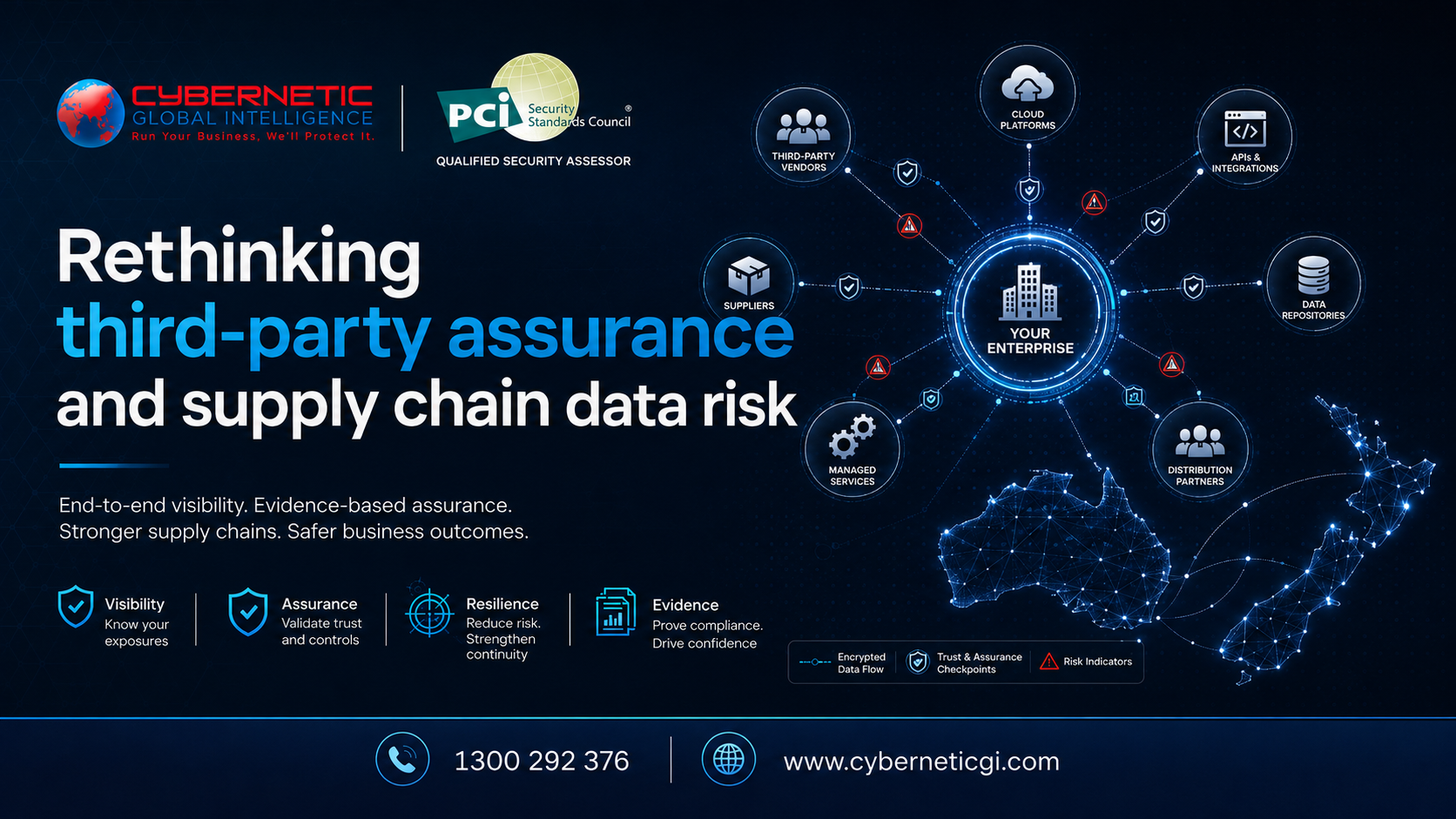
The moment customer data moves beyond your immediate operational environment, governance becomes more complex. Australian and New Zealand organisations routinely rely on external providers for customer service, technology operations, cloud platforms, and specialised business processes. Those arrangements may improve efficiency, but they also create dependencies that must be governed with the same discipline as internal systems.
The lesson for boards and risk leaders is straightforward: outsourcing a function does not remove the need to understand how information is accessed, protected, and monitored. Third-party risk must therefore be treated as an ongoing governance responsibility, not a procurement task completed when a contract is signed.
The Attack Surface Now Extends Through the Supply Chain
Origin Energy’s recent data security incident illustrates the scale of that challenge. Origin has said that information relating to approximately 900,000 current and former customers was accessed. Recent reporting has linked the investigation to a former Accenture employee in Manila, while the matter remains subject to an ongoing criminal investigation.
For organisations using offshore or distributed service models, the governance question is bigger than where data is stored. Leaders need to understand who can access it, from which locations, under what conditions, and with what level of monitoring.
That means assessing identity controls, privileged access, employee screening, data-loss prevention, endpoint security, logging, subcontractor exposure, and physical security where relevant. A cyber security audit of critical supplier relationships can help identify gaps that ordinary procurement reviews may miss.
In Australia, cross-border handling of personal information can also trigger specific privacy considerations. APP 8 requires organisations, in applicable circumstances, to take reasonable steps before disclosing personal information to overseas recipients. That makes supplier governance a compliance issue as well as a technical security concern.
Contracts Are Necessary, but They Are Not Assurance
Security schedules, contractual clauses, and annual vendor questionnaires all have a role. None of them proves that controls continue to operate effectively after the contract is signed.
This is where many third-party risk programs become too static. A supplier may satisfy requirements during onboarding, but its environment can change through staff turnover, technology changes, subcontracting, new integrations, or weakened operational discipline.
Assurance therefore needs evidence. Organisations should be able to test whether agreed controls are operating, whether exceptions are being tracked, and whether material changes in the supplier environment trigger reassessment.
Incident escalation also deserves particular attention. If suspicious activity appears within a supplier environment, responsibilities for investigation, evidence preservation, notification, and decision-making should already be clear. The organisation’s cyber incident response team must know how it will obtain timely information from the provider rather than discovering critical dependencies during a live incident.
Access Governance Is a Board-Level Question
Third-party breaches frequently expose a fundamental issue: too many organisations know which companies have access to sensitive information, but not necessarily which individuals do. That distinction matters.
Privileged access should be limited according to business need, reviewed regularly, and removed promptly when roles change or employment ends. High-risk access should also be supported by appropriate authentication, monitoring, and restrictions on bulk extraction or transfer of data.
A secure configuration review can help validate whether supplier environments reflect those expectations in practice. But configuration is only one part of the picture. Effective assurance should also examine joiner-mover-leaver processes, privileged account inventories, logging coverage, exception management, and evidence that offboarding controls actually work.
The objective is not to eliminate every third-party risk. It is to ensure that material risks are visible, owned, and supported by evidence.
Move from Compliance Evidence to Evidence-Based Assurance
Mature third-party governance asks a better question than, “Has the supplier completed the questionnaire?”
It asks: “What evidence demonstrates that the control is operating?”
For example, an organisation may request samples of access reviews, evidence of terminated-user deprovisioning, or security configuration outputs. It may also review penetration-testing results, incident-response exercises, data-flow maps, and records showing how contractual security obligations are monitored.
ISO 27001 information security auditors can provide valuable assurance over management systems, while targeted technical reviews can test controls that require deeper validation. Similarly, when engaging a certified cyber security consultant in Australia, organisations should look for assessments that connect technical findings directly to governance obligations, risk ownership, and remediation priorities.
At Cybernetic Global Intelligence, the focus is not simply on producing more assurance paperwork, but on turning control evidence into decisions that boards, CISOs, and risk leaders can act on.
Conclusion
Third-party assurance should not become an annual box-ticking exercise. Supplier environments change, people change, access changes, and threats change.
For ANZ organisations, the practical response is to make third-party risk part of routine governance. This means understanding where sensitive information flows and who can access it. It also means verifying that critical controls remain effective and ensuring incident responsibilities are clear before a problem occurs.
The strongest assurance programs do not rely solely on contracts or declarations. They combine governance oversight with evidence-based validation.
When organisations can demonstrate discipline across their supply chain, they are better positioned to protect customer information, meet compliance expectations, and respond decisively when risk becomes reality.