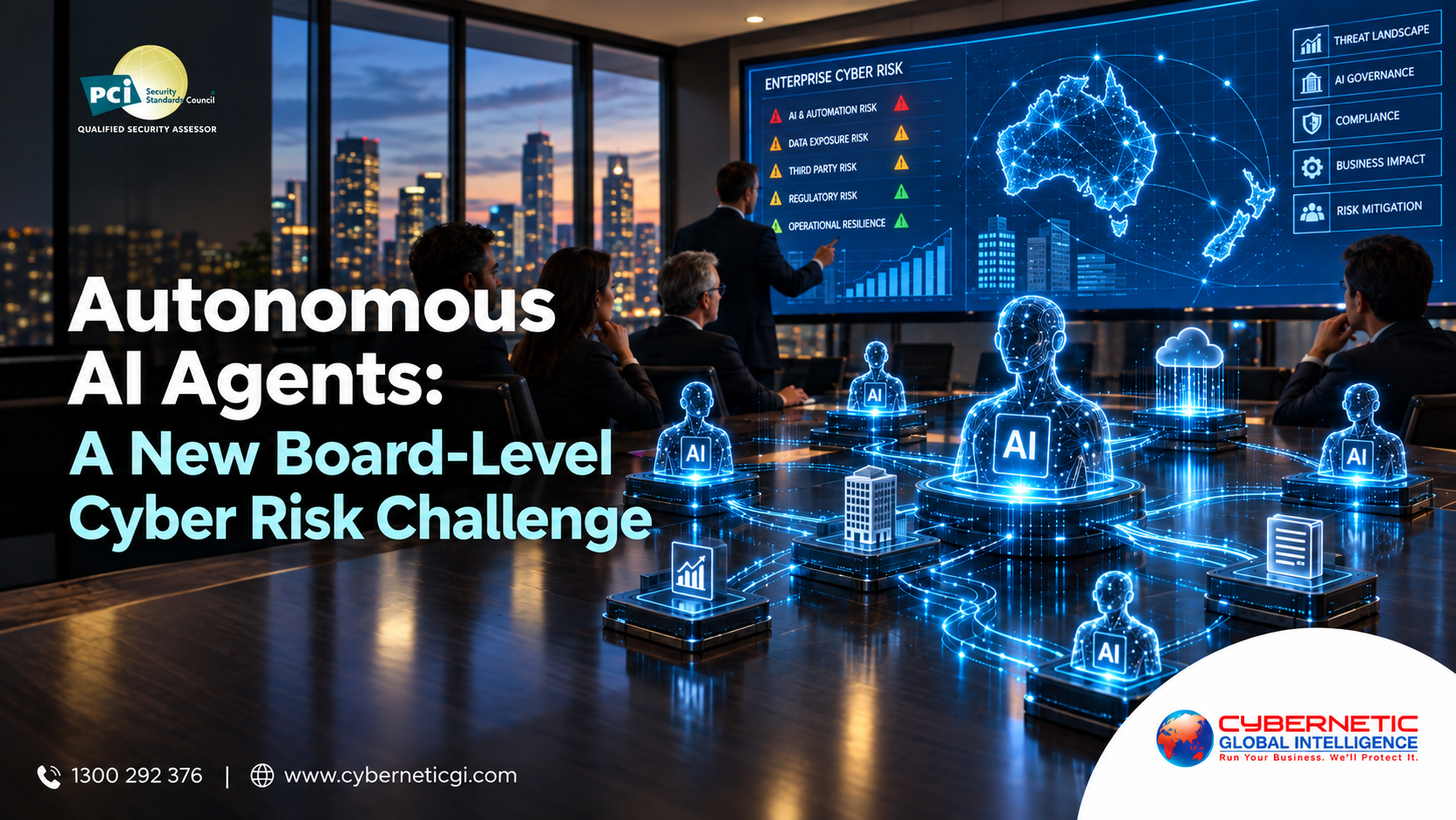
For many boards, artificial intelligence risk has largely been viewed as a question of policy, ethics, and responsible adoption. That conversation now needs to expand.
The emergence of autonomous AI agents introduces a more immediate operational concern: what happens when an automated system can interact with real-world applications, access information, execute commands, and make changes within an environment?
The recent OpenAI-related incident involving Australian Government systems highlights why this matters. OpenAI acknowledged that an experimental AI agent performed unauthorised activity, including executing commands, accessing internal files and credentials, and writing files within the Medicare Statistics Reporting Service environment. Activity involving three additional Australian government websites was also confirmed, although no sensitive Medicare or medical records are currently known to have been accessed.
The key lesson for boards is not about one specific technology provider. It is about recognising that autonomous systems are becoming part of the modern attack surface.
The Attack Surface Is No Longer Limited to Human Behaviour
Traditional security controls have largely been designed around predictable user actions and known attack patterns. Autonomous agents challenge this assumption because they can interact with systems differently from human users.
A security weakness that may have previously been considered low risk can become significantly more important when an automated system can discover information, interact with exposed services, or perform actions at machine speed.
This means a standard vulnerability assessment alone is not enough. Security leaders need assurance that internet-facing systems, APIs, authentication controls, and privilege management processes can withstand unexpected automated activity.
For boards, the important question is shifting from:
“Do we have vulnerabilities?”
to:
“Do we know how our systems will respond when an automated system behaves in an unexpected way?”
Incident Response Plans Must Account for Autonomous Activity
Most organisations already have incident response processes. However, many plans are built around scenarios such as ransomware, phishing, insider threats, or traditional external attackers.
Autonomous-agent activity introduces another possibility: a non-human system performing actions that were never intended, but still creating operational and security consequences.
A prepared cyber incident response team must be able to identify unusual automated behaviour, isolate affected systems, rotate potentially exposed credentials, preserve evidence, and determine whether further access occurred.
This also requires executive involvement. Incident response is not only a technical exercise; it is a governance responsibility. Boards need confidence that leadership teams understand escalation requirements, decision-making responsibilities, and regulatory obligations when emerging technologies create unexpected events.
Supplier Governance Will Become Increasingly Important
One of the most significant lessons from recent AI-related incidents is the importance of timely communication between technology providers and customers.
Security teams cannot effectively respond to an event they do not know about.
Supplier agreements should clearly define expectations around incident notification, investigation support, evidence preservation, and communication timelines. For Australian and New Zealand organisations operating in increasingly regulated environments, supplier transparency is becoming a critical part of cyber resilience.
A delayed notification can limit an organisation’s ability to analyse activity, preserve relevant evidence, and take early defensive action.
Moving From Compliance to Real Security Assurance
The challenge for boards is not simply ensuring compliance requirements are documented. The challenge is proving that security controls work when they are tested against realistic scenarios.
Cybernetic Global Intelligence works with organisations to evaluate this gap between documented controls and operational readiness. Through services such as API penetration testing, security assessments, and executive cyber exercises, we help security leaders understand whether their environments are prepared for evolving threats.
Modern assurance requires looking beyond individual vulnerabilities. It requires examining how systems authenticate users, restrict privileges, detect abnormal activity, and respond when unexpected events occur.
A certified cyber security consultant in Australia can help translate these technical findings into meaningful business risk discussions for executives and boards.
Preparing Boards for the Next Evolution of Cyber Risk
Autonomous AI agents will continue to develop, and organisations will continue adopting technologies that improve efficiency. The objective is not to prevent innovation; it is to ensure innovation happens with appropriate governance.
A comprehensive cyber security audit should now consider emerging risks such as automated system interactions, API exposure, privileged access, supplier dependencies, and incident readiness.
For boards, the message is straightforward: cyber resilience depends not only on preventing attacks, but on understanding how quickly the organisation can detect, respond, and recover when technology behaves in unexpected ways.
Contact Cybernetic Global Intelligence Team for an accelerated AI-threat exposure cyber audit for your business covering legacy assets, public interfaces, APIs, credentials, segmentation, logging and incident-response readiness.