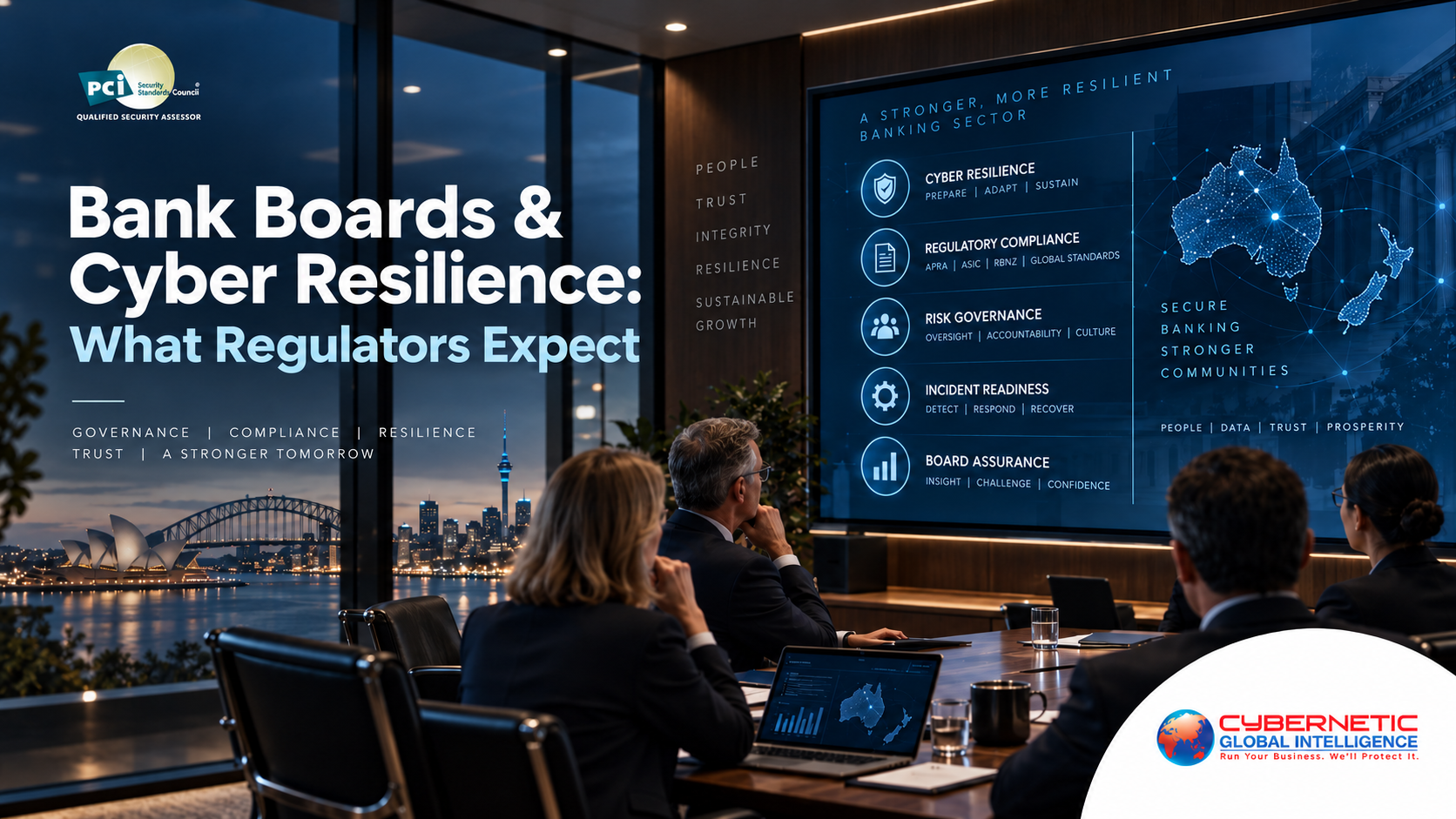
Across Australia and New Zealand, cyber resilience is increasingly a governance issue, not simply a technology issue. For bank boards, knowing that controls exist is no longer enough. The more important question is whether directors can demonstrate that critical operations, response arrangements and third-party dependencies are being challenged, tested and improved.
In Australia, APRA’s CPS 230 places the board at the centre of operational risk oversight, including business continuity and material service-provider arrangements. CPS 234 reinforces board responsibility for information security and requires systematic testing of controls. In New Zealand, the Reserve Bank’s cyber-resilience guidance similarly emphasises clear board and senior-management responsibilities.
Technical Reporting Is No Longer Enough
Boards still need technical information, but technical metrics alone do not demonstrate effective governance. Patch counts, firewall events and vulnerability numbers can show activity. They do not necessarily answer the questions directors need to ask:
1. Which critical services are most exposed?
2. What happens if a key system is unavailable?
3. Are recovery assumptions realistic?
4. Which control weaknesses remain unresolved, and who has accepted the associated risk?
A vulnerability assessment is useful, but it is only one input. Strong governance connects technical findings to business impact, risk appetite, critical operations and remediation decisions.
The same principle applies to incident readiness. Testing should show whether escalation paths, decision rights, communications and recovery processes work under pressure. A capable cyber incident response team matters, but the board also needs evidence that the wider organisation can make timely decisions during a severe but plausible disruption.
Third-Party Resilience Needs Board Visibility
Cloud platforms, managed service providers and other external partners may support critical banking operations, but outsourcing those services does not transfer responsibility for resilience.
Boards need visibility into material dependencies, service-provider performance, concentration risk and the consequences of supplier failure. They should understand where important information assets are managed externally and whether assurance over relevant controls is sufficient.
Instead of asking only whether a vendor is compliant, boards should ask how the provider supports critical operations and what testing supports confidence in recovery.
Independent Assurance Should Improve Decisions
Management reporting is essential, but it is not the same as independent assurance. Effective assurance tests whether controls are designed appropriately, operating as intended and being remediated when weaknesses are identified.
A cyber security audit can support that process when its scope is tied to the organisation’s risk profile and regulatory obligations. ISO 27001 can also provide a useful control framework. Organisations searching for ISO 27001 information security auditors should consider both their competence and independence, as well as whether their work provides useful governance assurance.
Likewise, organisations seeking a certified cyber security consultant in Australia should look beyond credentials alone. The real value lies in turning technical evidence into clear findings and prioritised actions that risk, audit and executive leaders can use to make decisions.
What Good Evidence Looks Like
For boards, evidence of cyber resilience should be clear in the governance trail. This includes agreed resilience tolerances and testing results, along with clear records of control weaknesses, remediation progress and significant third-party risk decisions.
At Cybernetic GI, the focus is on helping organisations turn security testing and assurance into evidence that boards can use to make informed decisions. The objective is not more reporting for its own sake. The goal is clearer assurance that critical operations can withstand disruption and that leaders know where action is still required.
Cyber resilience is not proven simply because a dashboard reports that controls are operating effectively. It is demonstrated through informed challenge, credible testing, independent assurance and timely action.
For bank boards, the distinction is between being told the organisation is resilient and having evidence that supports that conclusion.